Foundation surface
The substrate surface must be free from oil, grease or any loosely adherent material. If the concrete surface is defective or has laitance, it must be cut back to a sound base. Bolt holes and fixing pockets must be blown clean of any dirt or debris.
Pre-soaking
Several hours prior to placing, the concrete substrates should be saturated with fresh water. Immediately before grouting takes place, any free water should be removed with particular care being taken to blow out all bolt holes and pockets.
Base plate
It is essential that this is clean and free from oil, grease or scale. Air pressure relief holes should be provided to allow venting of any isolated high spots.
Levelling shims
If these are to be removed after the grout has hardened, they should be treated with a thin layer of grease.
Formwork
The formwork should be constructed to be leakproof. This can be achieved by using foam rubber strip or mastic sealant beneath the constructed formwork and between joints.
In some cases, it is practical to use a sacrificial semi-dry sand and cement formwork. The formwork should include outlets for pre-soaking.
Unrestrained surface area
This must be kept to a minimum. Generally, the gap width between the perimeter formwork and the plate edge should not exceed 150mm on the pouring side and 50mm on the opposite side. It is advisable, where practical, to have no gap at the flank sides.
Mixing and placing
Mixing
For best results, a mechanically powered grout mixer should be used. When quantities up to 50kg are used, a heavy-duty slow speed drill (400-500 rpm) fitted with a paddle is suitable. Larger quantities will require a heavy-duty mixer.
To enable the grouting operation to be carried out continuously, it is essential that sufficient mixing capacity and labour are available. The use of a grout holding tank with provision to gently agitate the grout may be required.
Consistency of grout mix
The quantity of clean water required to be added to a 25kg bag to achieve the desired consistency is given below:
- Pourable: 4.125 litres
- Flowable: 4.5 litres
The selected water content should be accurately measured into the mixer. The total content of the Conbextra GP2 bag should be slowly added and continuous mixing should take place for 5 minutes. This will ensure that the grout has a smooth, even consistency.
Placing
At 30°C, place the grout within 20 minutes of mixing to gain full benefit of the expansion process.
Conbextra GP2 can be placed in thicknesses up to 100mm in a single pour when used as an underplate grout.
For thicker sections, it is necessary to fill out Conbextra GP2 with well-graded silt-free aggregate to minimise heat build-up. Typically, a 10mm aggregate is suitable. 50 – 100% aggregate by weight of Conbextra GP2 can be added.
Any bolt pockets must be grouted prior to grouting between the substrate and the base plate.
Continuous grout flow is essential. Sufficient grout must be prepared before starting. The time taken to pour a batch must be regulated to the time to prepare the next one.
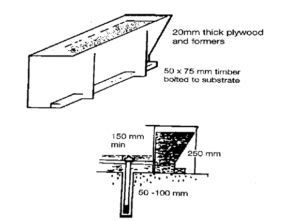
Typical hopper system
Removable hopper: For large pours, the grout may be hand placed or pumped into a removable hopper (trough). Pouring should be from one side of the void to eliminate any air or presoaked water becoming trapped under the base plate.
It is advisable to pour the grout across the shortest distance of travel. The grout head must be maintained at all times so that a continuous grout front is achieved.
Where large volumes have to be placed, Conbextra GP2 may be pumped. A heavy-duty diaphragm pump is recommended for this purpose. Screw feed and piston pumps may also be suitable.
Curing
On completion of the grouting operation, exposed areas should be thoroughly cured. This should be done by the use of Concure WB curing membrane, continuous application of water and/or wet hessian.



Reviews
Clear filtersThere are no reviews yet.